




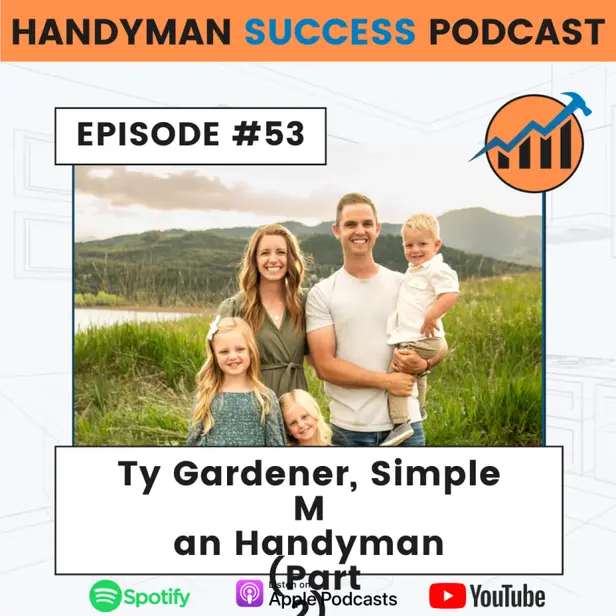
Growing a handyman business from the ground up is no easy feat, but it’s incredibly rewarding when done right. Ty Gardener, founder of Simple Man Handyman, shares his journey, insights, and practical strategies for building a thriving local business.
🔍 How Ty Built His Client Base: Organic Growth and Local Trust
One of the standout attributes Ty credits for his success is his frugality—he’s cautious about spending money on customer acquisition. Instead, he focuses heavily on building a strong online presence and leveraging local connections.
Ty’s website has been a cornerstone of his marketing strategy. Although he doesn’t consider himself a web expert, he invested significant effort early on to create a quality website that ranks well on Google. This organic search visibility drives the majority of his leads today, proving that a well-optimized site is invaluable for handyman businesses.
“We get so many people complimenting the website,” Ty says. “We’re really localized. A guy recently reached out to me saying, ‘You’re the guys in Loveland, right?’ That’s the impression people get just from Googling us.”
Besides online visibility, Ty also benefited immensely from local word-of-mouth referrals, especially early on when friends, family, and neighbors trusted him with jobs. Although his skills have greatly improved over the years, that initial trust helped get his foot in the door.
Interestingly, Ty doesn’t actively push for referrals or repeat business. Instead, he lets quality work speak for itself. Going above and beyond for customers naturally generates repeat clients and word-of-mouth recommendations, which serve as a powerful secondary source of new business.
💰 Navigating the Pricing Journey: From $20/hr to Premium Rates
Pricing is one of the biggest challenges Ty faced when starting out. His first experience bidding handyman work was for a roofing company subcontracting gig at just $20 an hour. His boss quickly advised him that rate was too low to be profitable, setting Ty on a course to research and refine his pricing strategy.
When launching Simple Man Handyman, Ty aimed for $70 to $80 an hour, but early jobs sometimes felt awkward charging friends and family that much. For example, he recalls charging a family friend $65 per hour, which was a big jump from the $10 per hour he earned as a kid, and that client never hired him again.
Over time, Ty moved away from hourly billing entirely, focusing instead on fixed-price estimates. Initially, his bids were all over the place—some jobs yielded $150 per hour in value, while others barely made $5 per hour. But with six years of experience, he developed a reliable price list for common tasks and learned how to estimate larger custom jobs within profitable ranges.
Ty’s average effective hourly rate increased steadily each year:
- First year: Around $60/hour billable
- Last year: About $98/hour
- Current year: Approximately $130/hour after a recent price increase
He emphasizes that raising prices not only boosts profitability but also attracts higher-end clients who expect and appreciate premium service. “The customers that we charged more to are like our happiest customers,” Ty shares. “It’s so much easier to do a great job when you’ve bid appropriately and aren’t stressed about underbidding.”
Charging premium rates also shifts client expectations positively—clients expect attention to detail, professionalism, and respect for their home, which creates a win-win situation where both the handyman and customer are happy.
📋 Estimating Jobs: Balancing Virtual and In-Person Consultations
Estimating is another critical piece of Ty’s business. About 60% of estimates are handled virtually, often for straightforward tasks like installing light fixtures, TV mounts, or garbage disposals. Customers can fill out forms or send pictures, and Ty provides quick quotes without needing to visit the site.
However, Ty also values in-person consultations, which make up roughly 40% of his estimates. He enjoys meeting customers face-to-face, understanding their specific needs, and building trust—something he believes increases his job conversion rates.
🛠️ Favorite and Profitable Handyman Jobs
When asked about his favorite jobs, Ty highlights the variety that makes handyman work enjoyable for him. He prefers not to do the same task repeatedly but rather appreciates the mix of different projects.
His bread-and-butter jobs include:
- TV mounting
- Installing light fixtures and ceiling fans
- Replacing faucets and garbage disposals
- Custom carpentry projects such as building bench seats or mudroom storage
- Installing sliding barn doors, which are popular and profitable
These tasks are quick, straightforward, and profitable. For example, light fixture installs are frequent and easy to price. Custom carpentry jobs, while more labor-intensive, offer a chance to showcase craftsmanship and command higher prices.
Typically, Ty’s average ticket price hovers around $850, which usually equates to a day’s work for one person or a few hours for a two-person crew. Many jobs involve a mix of smaller tasks—like a punch list with light fixture replacements, drywall patches, and trim work—combined into a single estimate to reach that average ticket amount.
🎯 Parting Advice for New Handyman Business Owners
Ty’s advice for those starting a handyman business is encouraging and grounded in real-world experience:
- Don’t let lack of experience hold you back. Even if you’re not highly skilled yet, there are plenty of resources to learn from, and many jobs require only basic skills combined with a commitment to quality.
- Be ready for hard work. Running a business is challenging and requires perseverance, especially in the early years. Ty admits to moments of doubt but emphasizes the fulfillment that comes from helping people and building trust.
- Focus on helping people. The desire to serve and uplift customers is what sustains long-term motivation, more than just chasing growth or profits.
Ty shares a personal reflection on how his original goal of helping people—initially tied to a career in physical therapy—found a new home in his handyman business. “It’s really cool when customers rely on you and count on you,” he says. “That makes all the hard work worth it.”
🚀 Final Thoughts
Ty Gardener’s journey with Simple Man Handyman offers a blueprint for sustainable growth rooted in service, smart pricing, and strong local presence. His emphasis on organic leads through a quality website, combined with his evolving pricing strategy and balanced approach to estimating, reveals the power of patience and consistency in building a successful handyman business.
For anyone looking to start or grow their handyman service, Ty’s story is a reminder that you don’t need to be an expert from day one. You need dedication, a commitment to quality, and the willingness to learn and adapt. With these, you can build a business that not only thrives financially but also brings genuine satisfaction from helping your community.