



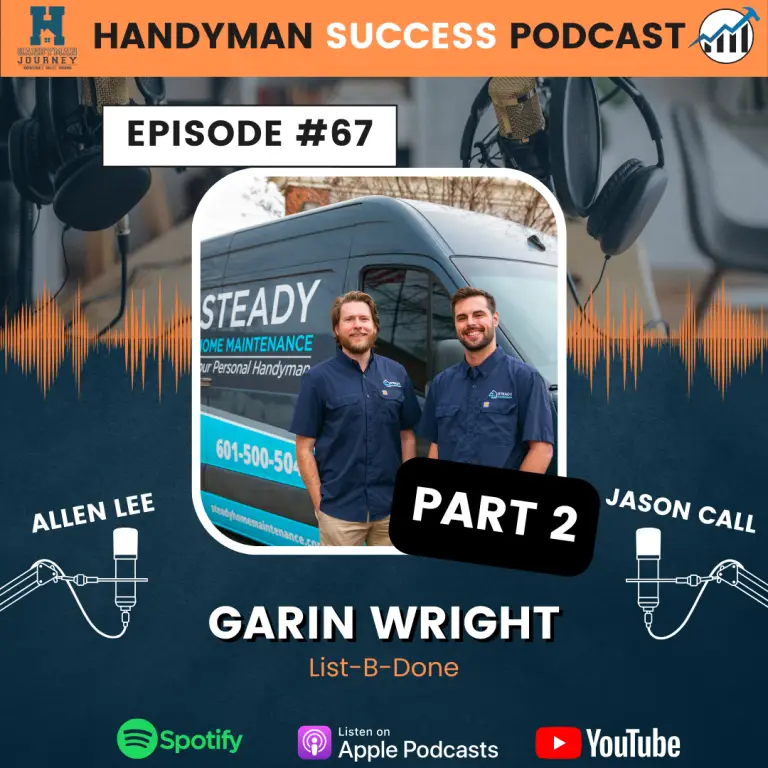
Scaling a handyman business is more than getting more leads. It is about building a company people want to work for and customers trust before they call. J.R. Crowell from Steady Home Maintenance‘s approach emphasizes culture, clear systems, and relentless focus on making work easy for both customers and techs. The goal is to move from owner-operator chaos to a predictable, repeatable business that can scale without the owner doing every job.
🌟 Vivid vision and core values
J.R. uses a three-year “vivid vision” exercise to picture where the business should be—not the how, but the what. That vision drives actionable core values that are repeated daily. Key values include:
- Clear a path — prepare the next person so they can succeed.
- Easy to work with, easy to work for — reduce friction for customers and employees.
- Be proactive, set clear expectations, and keep things professional and fun.
These values are a filter for hiring, daily meetings, and decisions. They are not slogans but behavioral standards that inform operations and culture.
🧭 Hiring: the catch-22 and non-traditional hires
Hiring faces a classic tension: bring on highly skilled tradespeople who might resist prescribed systems, or hire green workers and invest time to train them. Each path has trade-offs. Skilled veterans can carry the business but may bring ingrained habits that conflict with company methods. Green hires require more short-term investment but can be molded to match culture and processes.
J.R. also highlights the value of non-traditional hires—people coming from other industries who need a chance. They often have the right attitude and can become strong contributors when the company provides structure, pay guarantees, and a simplified work funnel that removes business-side headaches for craftsmen.
📚 Training and SOPs: the Notion playbook
Training happens without fail every Friday for an hour, emphasizing sales and communication. J.R. calls communication training the “cheat code.” Hard-skill training exists too, but improving how the team communicates internally and with customers unlocked outsized improvements.
The team uses Notion as a searchable internal SOP database. For any request—say a door replacement—a tech can search “door” and find:
- What to ask on the first call
- The 12 tools required for the job
- A step-by-step job checklist with dozens of bullet points and if-then scenarios
Notion also marks incomplete or experimental systems so employees can improve them. This creates a living manual that captures tribal knowledge and turns it into repeatable processes.
🧰 Operations: make-it-easy systems
Small operational choices multiply retention and speed. Examples:
- Standardize on four types of caulk and sealant so techs don’t overthink material choice
- Post visual “green checks and red Xs” in trucks and at the stockroom for quick reference
- Prepped job crates labeled with the job name so techs can grab-and-go
- QR codes for ordering and automations that route jobs based on price and scope
- Centralized ordering to keep techs out of big box stores whenever possible
The underlying theme is to remove friction. When employees feel supported and know the next step, culture strengthens and customers notice.
💼 Compensation, transparency, and EOS
Culture gets protected by doing what the company promises. J.R. uses open-book management so everyone can see the P&L and understand how their actions move the needle. Performance pay ties compensation to results.
For organization and role clarity, the Entrepreneurial Operating System (EOS) was implemented. EOS helps define “who’s in the right seat” and creates a cadence of meetings, scorecards, and rocks. It works best when revenue and headcount hit a certain level, but J.R. adapted a pared-down version for smaller teams and spun remodel operations into its own unit with a key three.
📣 Marketing tactics that actually work
Marketing is pragmatic and market-specific. Tactics that produced results include:
- Realtor relationships—doing punch lists and building referral pipelines at almost no cost
- EDDM direct mail for neighborhood targeting (use it to get routes, then consider alternate print shops)
- Google reviews—reaching 25 to 30 reviews changes local visibility
- Google LSA and modest PPC to capture intent-driven leads
- Content marketing and YouTube as a long-term lever for leads and an owned revenue stream
J.R. recommends focusing spend where it scales. Early on, hyper-targeted outreach and relationships beat broad paid funnels that demand constant attention.
💳 Subscription maintenance: trials, errors, and pivots
Subscription-based maintenance is tempting but tricky. J.R. tested multiple models and learned that market fit matters more than the idea.
- Done-for-you annual maintenance sold poorly in his market; homeowners preferred on-call access or discounted memberships.
- Quarterly visit plans failed when work finished quickly and customers wanted to bank unused hours.
- The current model leans toward a tiered membership: a low-cost “join the club” discount-only entry and a mid-level plan with mandatory annual or quarterly touchpoints to ensure the team gets into homes regularly.
The lesson: if a membership doesn’t create recurring touchpoints or meaningful value for members and the company, it will be a money loser. Target affluent, maintenance-conscious markets or partner with builders and HOAs for better fit.
🤖 AI and wearable tools: leverage quickly
J.R. urges embracing AI fast. Practical uses include chat bots for initial estimating, automations, and even wearable recorders that capture a tech’s day to accelerate SOP creation. AI reduces repetitive work, speeds quoting, and helps scale without proportionate headcount increases.
🏁 Parting advice for new and scaling handymen
Key takeaways for business owners:
- Decide early: be an owner-operator or scale a business. Both are valid but require different systems and expectations.
- Document systems: even simple checklists are systems. Write things down so hiring and delegation become possible.
- Train for communication: technical skill alone does not create consistent outcomes—communication does.
- Leverage AI: adopt it to save time and money where it makes sense.
- Protect culture: live your values, pay transparently, and empower your team with clarity on their roles.
The path from chaotic solo hustle to a stable, scalable handyman company is deliberate work: define a vivid vision, build simple systems that make work easy, train relentlessly, and be willing to adapt marketing and membership models to fit the local market. When systems and people align, growth follows.