




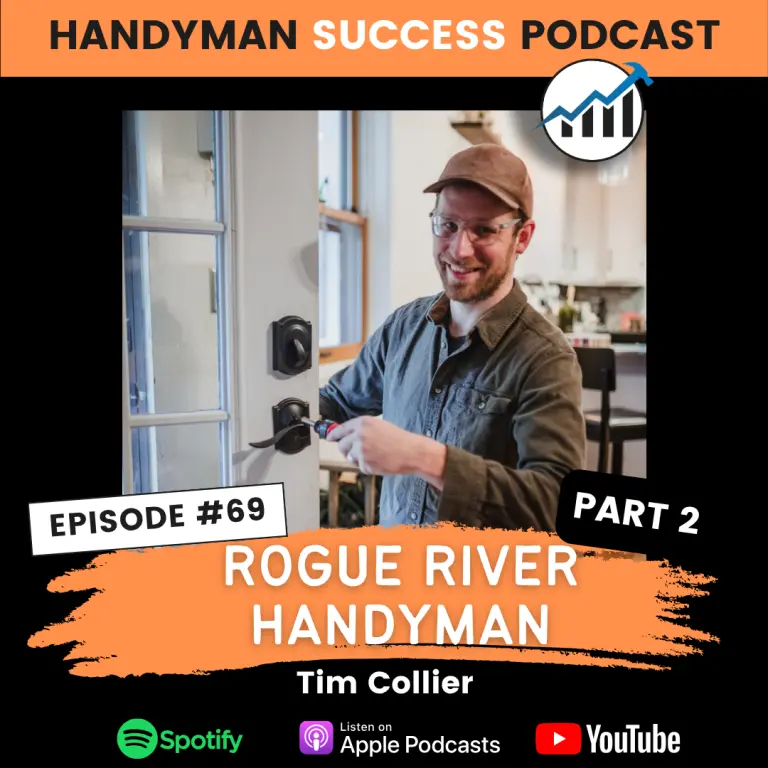
Handyman Success Podcast: How Rogue River Handyman Built a Profitable Part-Time Business
One of the biggest questions new handymen wrestle with is simple: how do you price the work? Right behind that is another one: can this actually work part-time?
Tim Collier of Rogue River Handyman offers a helpful answer to both. He has built a highly professional part-time handyman business in the Grand Rapids, Michigan area while also balancing ministry work, family life, and a full schedule. And he has done it in a way that looks anything but part-time. With strong reviews, a polished presentation, and a clear sense of what jobs fit his business, Tim’s story shows that a side hustle can become a serious operation when it is approached with intention.
This conversation covered the full picture: scheduling, quoting, pricing, job selection, confidence, mistakes, and the kinds of jobs that work especially well for someone running a handyman business on limited time.
🛠️ Part-Time Does Not Mean Unprofessional
One of the most encouraging takeaways from Tim’s experience is that part-time does not have to look small, sloppy, or uncertain. He approaches his business like a real business. That means presenting himself professionally, communicating clearly, and creating trust before he ever starts a job.
That matters because many people assume customers will hesitate if they learn a handyman is only doing this on the side. Tim has found that it is usually better not to lead with that label. Instead, he focuses on doing quality work, being responsive, and showing up like a pro.
Later, once the relationship with the client develops, it often comes up naturally that he also has another job. By that point, the customer already knows who he is. They have seen the professionalism, the care, and the results.
That approach helps avoid an unhelpful stereotype. A “part-time handyman” can sound casual. A well-run handyman business that happens to operate on a part-time schedule is something entirely different.
📅 How a Part-Time Handyman Can Schedule Work
Scheduling is one of the trickiest parts of building a part-time handyman business. Tim’s approach is simple: segment the week into buckets.
His default is to reserve certain days for handyman work, especially Mondays and Wednesdays. That gives him a basic structure. But he also acknowledges that real life rarely stays neatly inside those lines. Family needs come up. Ministry meetings shift. Clients are only available at certain times. So while the schedule has a framework, it still needs flexibility.
A few practical scheduling habits stood out:
- Dedicated workdays: Setting aside recurring days helps protect time for the business.
- Home visits on the way home: If a lead needs a quick in-person look, Tim often stops by between 5:00 and 6:00 p.m. when people are home from work.
- Short quote visits: Not every lead needs a long consultation. Sometimes a quick visual check is enough.
- Clear communication: If he cannot get to a job until next week, he simply says so.
That last point is important. A lot of new handymen fear losing work if they cannot respond immediately. Tim’s experience suggests that honest communication goes a long way. He does not over-explain. He just lets clients know when he is available and works from there.
💵 How Tim Learned to Price Handyman Jobs
At the beginning, Tim admits he was doing what many new handymen do: pulling numbers out of thin air.
He was coming from hourly work with another contractor, so he had some sense of labor value, but pricing complete jobs was a different skill. Early on, he would estimate based on what the job felt worth to him. That is common, but it only gets someone so far.
Over time, he sharpened his pricing in a few ways:
- He paid attention to what other handymen were charging for similar work.
- He compared those numbers to his local market in Michigan.
- He adjusted based on his current skill level and efficiency.
- He started thinking in terms of daily revenue targets.
That daily rate mindset was a big shift. Rather than pricing every job from scratch in a vacuum, Tim began asking: How much do I want to make in a day?
His target became roughly:
- $600 to $800 per day
From there, he could reverse-engineer many of his estimates:
- Half-day job: around $350 to $400
- Full-day job: around $650 to $750
- More than a day: closer to $1,000 or more
That is not a perfect formula for every business, but it gave him a practical pricing framework. For many handymen, that is a major improvement over guessing.
📸 Why Photos Make Pricing Faster and Better
One of Tim’s smartest systems is requiring photos whenever possible.
He uses a form on his website that lets people submit pictures of the work they need done. Those photos help him answer several questions quickly:
- Can he do the job?
- Does he need to visit in person?
- Can he estimate accurately from the images alone?
This works especially well for drywall repair, which has become one of his strongest categories. Once he sees the size, location, and surrounding texture, he can often quote the job without making a separate trip.
For example, his drywall pricing has become much more consistent:
- Small 12×12 drywall hole: around $350 to $400
- Ceiling patch with texture matching: closer to $500
- Texture matching add-on: about $75 extra
That kind of confidence only comes with repetition, but photos help speed up the learning process.
🔨 The Best Handyman Jobs for a Part-Time Business
Not every job is ideal for a part-time handyman. Tim highlighted a few categories that fit his schedule and skill set especially well.
Drywall repair
This is his top pick. It became profitable when he improved both skill and process. Early on, a drywall patch might take him three or four days with multiple visits because he was waiting for materials to dry. Once he learned to use hot mud and developed what he called his “drywall bag of tricks,” he could complete many repairs in a single afternoon.
That created a huge leap in efficiency and confidence.
Deck repair and trim carpentry
He enjoys work that involves cutting wood and making visible improvements. Deck repair, baseboards, and door casing all fit that category. These jobs can be satisfying, straightforward, and attractive to homeowners who need targeted repairs instead of a full remodel.
Honey-do lists and small item bundles
Jobs like replacing a kitchen faucet, fixing a door sweep, tightening loose hardware, or knocking out several minor repairs in one home can be excellent for profitability. Rather than driving from house to house for one tiny task, Tim can complete a list of jobs in a single visit and increase revenue through efficiency.
Those bundled small jobs often produce a lot of customer appreciation too. What feels simple to a professional can feel transformative to a homeowner.
🚫 When Saying No Makes More Money
One of the clearest lessons from the conversation was this: saying yes to the wrong job can cost more than saying no.
Tim shared a painful example from a luxury steel pergola assembly job. He expected it to be a straightforward install and quoted it at about a half day based on what he had heard. Instead, the project dragged out to nearly a week due to complications, delays, and reordered parts.
That kind of job can drain time, confidence, and profit.
The lesson was not just about pergolas. It was about boundaries.
New handymen often feel pressure to say yes because they want the work or because lead flow is slow. Tim admitted that he is more likely to say yes to questionable jobs when he feels less confident and has fewer leads coming in. That is a valuable insight.
Sometimes the answer is simply:
- I’m not the right fit for that.
- That’s not a service I offer.
- I’m not comfortable taking that one on.
Customers usually appreciate that honesty. It is better for them and better for the business.
📈 Why Most New Handymen Undercharge
The broader discussion around pricing touched on something nearly every handyman faces: undercharging.
In the early stages, many people price emotionally. They think about what feels fair, what the customer might think, or how badly they need the job. But those are unstable pricing inputs.
Better pricing gets built on:
- Experience
- Knowing how long jobs actually take
- Understanding business expenses
- Confidence in the value being delivered
The hosts also stressed that pricing confidence improves when handymen know their numbers. That is what allows someone to quote without getting pulled around by fear, low lead flow, or assumptions about what the client can pay.
In other words, confident pricing is not arrogance. It is clarity.
🏡 The Unexpected Personal Wins of Handyman Work
Some of the most meaningful parts of Tim’s story had nothing to do with drywall, faucets, or daily rates.
For him, handyman work has created several “win-win-win” outcomes in life.
It has given him a way to connect with his community. After moving from the city to the suburbs, he noticed people were less naturally neighborly. Running a handyman business gave him an entry point into relationships. It opened doors, literally and figuratively, into the lives of people in his area.
It has also created something tangible for his kids to see. His ministry work is deeply meaningful, but often intangible and long-term. Handyman work is different. His children can see the project, understand the result, and even learn the skills alongside him.
And finally, the work satisfies a different part of who he is. It combines problem-solving, physical effort, visible progress, and the simple satisfaction of completing something useful for another person.
That combination helps explain why handyman work can be so rewarding even before the money enters the picture.
✅ Final Advice for Anyone Considering a Part-Time Handyman Business
For someone wondering whether they can do this part-time, Tim’s advice is straightforward: give it a shot.
He believes one of the best things about starting part-time is that it does not require a giant leap. A person can start with what they know, offer a few services, work a couple evenings or one day on the weekend, and learn as they go.
His advice for beginners can be summed up like this:
- Start with the skills you already have.
- Do not pretend to know what you do not know.
- It is okay to turn down jobs.
- Use each job to improve your pricing and systems.
- Professionalism matters, even if the business is part-time.
He also pushed back on a common myth: that someone has to be “born into it” or have construction in their blood to become a handyman. Skills can be learned. Confidence can be built. Experience can be earned one job at a time.
There will be mistakes. Everyone underprices. Everyone misjudges a job. Everyone says yes to something they should not have at some point. That is not failure. That is part of becoming competent.
For handymen trying to build a real business with confidence and clarity, Tim’s story is a good reminder that growth rarely starts with perfect knowledge. It starts with honesty, effort, repetition, and the willingness to keep improving.