




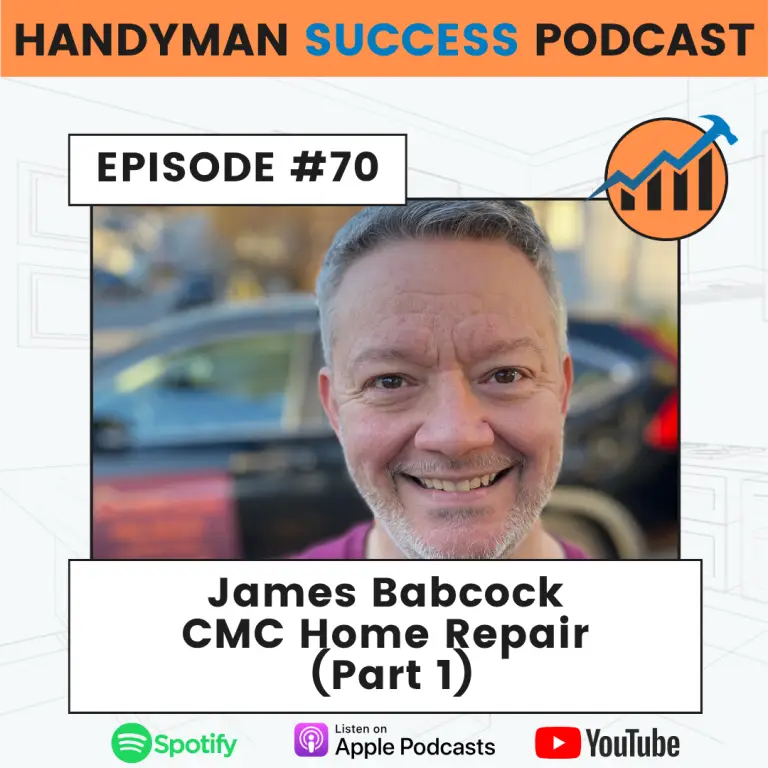
Some business stories are about explosive growth. Others are about grit, honesty, and figuring things out one step at a time.
James Babcock of CMC Home Repairs falls firmly into that second category, and that is exactly why his story is so valuable for handyman business owners. His path into the trades was not the typical one. He spent about 20 years as a professional actor before realizing something had changed. The work that once mattered deeply to him no longer lit him up. When he was cast in a dream role, the lead in Macbeth, and still could not bring himself to care about preparing for it, that became the clearest sign possible that it was time to move on.
What followed was not a perfect, polished leap into success. It was a season of uncertainty, identity shifts, financial stress, and trying different jobs. Eventually, James landed at an Ace Hardware store outside Boston, in Massachusetts’ South Shore area. That job helped reconnect him with something he had loved long before acting took center stage: solving problems, fixing things, and helping people.
That rediscovery became the foundation for a growing handyman business.
🧰 How CMC Home Repairs Got Started
James formed CMC Home Repairs while still employed at the hardware store. He joked that he was basically building one business while on the clock at another. Like many new owners, he started part-time first.
That slower entry mattered for two reasons:
- It reduced risk. His wife was understandably more conservative about making a full leap.
- It gave him time to test demand. Nights and weekends turned into real jobs, real customers, and real income.
For about eight months, he balanced both worlds. Then the handyman side started growing to the point where his day job became an obstacle instead of a safety net.
That is often the clearest sign a business is ready for more attention. Not when it feels perfectly safe, but when splitting energy between two jobs starts hurting both.
James described the tipping point simply: every time he went into work, he felt frustrated because he knew he needed that time for his own customers. He realized that if he kept going, he would either slack off at the hardware store or neglect his business. Neither was a good option. So he made the jump.
📈 When Is the Right Time to Go Full-Time?
This is one of the most useful parts of the conversation because so many handymen wrestle with the same question.
There was no magic formula. No exact savings number. No polished transition plan.
His wife would have preferred a larger financial cushion, but building a big savings reserve was difficult on that income. Instead, the decision was driven by a mix of demand and clarity.
Here is the practical takeaway for handymen wondering when to leave a day job:
- If the side business keeps growing
- If the day job is blocking income opportunities
- If you are mentally checked out of the day job
- If customers are already proving there is demand
…then it may be time to seriously consider the move.
That does not mean being reckless. It means being honest. A full-time business rarely arrives with zero fear attached.
📣 First Clients: What Worked and What Did Not
Like many newer handyman businesses, James started client acquisition through Angi, formerly Angie’s List. He admitted he did not really know what he was doing at first, and the platform helped him get those early jobs.
That matters because there is a tendency in the industry to dismiss pay-per-lead platforms entirely. But the truth is more nuanced.
For James, Angi was helpful for roughly the first 8 to 10 months. It gave him access to customers, and many of those customers eventually became repeat clients. That early momentum helped build his business.
Then the downside showed up:
- Lead quality dropped
- Returns on spend got worse
- He was getting charged for leads that did not turn into work
At that point, he left the platform.
This is a smart framework for new handymen:
- Use lead platforms carefully if you need to get started.
- Do not build your whole business on rented leads.
- Shift toward assets you own, especially Google reviews and your own website.
That transition is critical. When you stop paying a lead platform, the leads stop. But a strong Google Business Profile, a steady review base, and a professional website continue building value over time.
⭐ Why Repeat Customers Matter So Much
One of the best numbers James shared was this: about 90% of his clients are repeat customers.
That is huge.
Repeat business is one of the strongest indicators that a handyman operation is doing something right. It means the work is solid, the customer experience is good, and the relationship is strong enough that clients come back instead of shopping around every time.
Repeat customers also make business ownership less stressful. Marketing costs go down. Trust is already built. Estimates often move faster. And premium pricing becomes easier over time because clients know the value being delivered.
For newer handymen, this is worth remembering: getting the first job is great, but building the kind of service that turns into the second, third, and fourth job is where real stability starts to happen.
💻 The Website Lesson: DIY Has Limits
James also tried building his own website. His review of that effort was brutally honest and pretty funny. He said it looked like a middle-aged guy tried to build it, and even joked that if a five-year-old had built it, it might have looked better.
That kind of honesty is refreshing, and it highlights a very common issue in handyman businesses. Owners try to do everything themselves, including tasks that are far outside their best skill set.
There is nothing wrong with starting scrappy. But there comes a point where a poor online presence can actively hurt trust. If a website looks unprofessional, that can undermine otherwise excellent work.
The long-term marketing advice discussed around his story was simple and solid:
- Start a Google Business Profile as early as possible
- Begin collecting five-star reviews immediately
- Build a professional website when budget allows
- Create marketing assets you own instead of relying only on pay-per-lead services
💰 Revenue Numbers and Why Progress Matters More Than Perfection
James shared numbers that many early-stage business owners will find refreshingly real.
His first year brought in just under $50,000 in revenue, covering roughly April through December and including his part-time period. He also operated at a loss that year, which he had expected.
That can sound discouraging at first, but it is not unusual. Startup years are expensive. Tools, insurance, mileage, setup costs, and underpricing all hit at once.
More importantly, he knew his numbers. He used QuickBooks early and found an accountant to help him understand what was really happening financially.
That alone puts him ahead of many small operators.
The larger lesson from the discussion was this: do not compare your chapter one to someone else’s chapter ten. One of the hosts referenced the idea that everyone is “riding different ponies.” In other words, different backgrounds, markets, obligations, personalities, and timelines all matter.
What matters most is progression.
James moved from:
- part-time uncertainty
- to steady repeat customers
- to better systems
- to Google reviews
- to a professional website
- to improved pricing
🧾 Pricing Mistakes, Hourly Rates, and Flat Rate Learning
If there was one area where James was especially candid, it was pricing.
He started around $60 an hour. Very quickly, he realized that was too low. He bumped to $70, then $75, and eventually started targeting closer to $100 an hour on many jobs.
That pricing journey is incredibly common in the handyman world. New operators often choose rates based on what feels emotionally safe instead of what the business actually requires.
The problem is that low pricing creates a trap:
- You stay busy
- You feel needed
- But you are working hard without enough profit
James now generally uses flat rate pricing while keeping an hourly target in mind behind the scenes. That is a strong approach for many handymen. He knows roughly what a standard door install should take, for example, so he prices those jobs by the project. But when there is uncertainty, such as rot repair beneath an exterior threshold, he switches to hourly because hidden conditions can change everything.
He also uses a two-hour minimum for smaller jobs.
Those are useful benchmarks for other handymen to consider:
- Starting rate he regretted: $60/hour
- Rates he moved through: $70, then $75
- Current target on many jobs: around $100/hour
- Minimum charge for small jobs: two hours
- Preferred estimating method: flat rate, with hourly reserved for unknowns
The hosts made a strong point around this too: raising rates often does not reduce quality opportunities. In many cases, it improves the level of clientele you attract.
🔧 Key Takeaways for Handymen Building a Business
James Babcock’s journey offers several practical lessons worth keeping close:
- Career change takes courage, especially when identity and income are wrapped up in the old path.
- Part-time can be a smart bridge into full-time business ownership.
- Lead platforms can help you start, but they should not be your long-term marketing plan.
- Google reviews and a real website matter because they become assets you own.
- Repeat customers are gold, and 90% repeat business says a lot about service quality.
- Know your numbers early with bookkeeping and an accountant.
- Raise your rates when the numbers show you need to. Staying cheap is not a strategy.
- Progress matters more than comparing yourself to others.
James’s story is not about overnight success. It is about building something real, one lesson at a time. For handymen trying to figure out when to make a move, how to get first clients, or how to price work without constantly second-guessing themselves, that kind of honest story is often the most helpful kind.
And maybe the best summary came from one of the lighter moments in the conversation: it is funny how math works. The numbers do not lie. Know them, learn from them, and let them help shape a better business.