

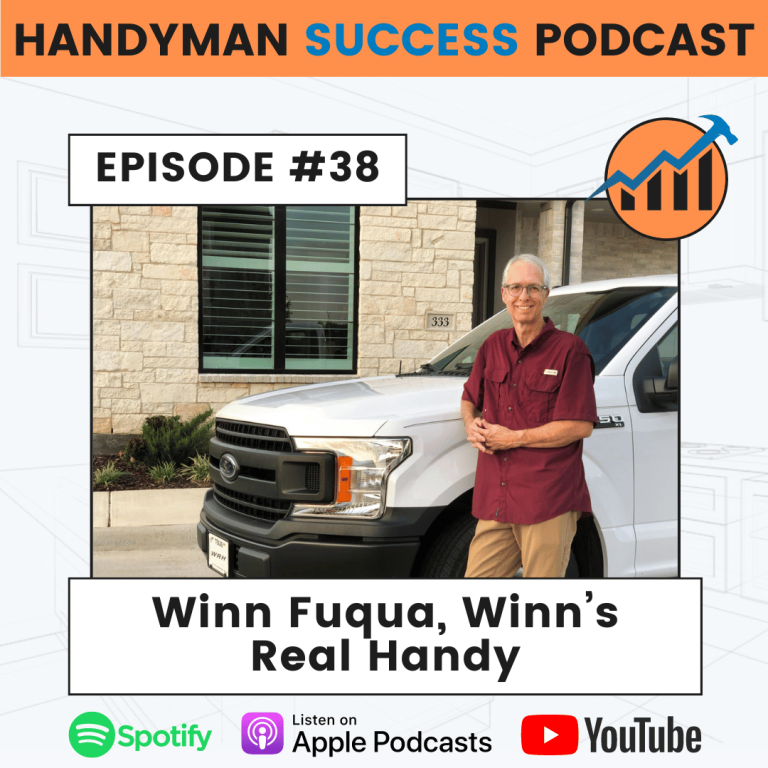
Jason Call [00:00:03]:
Hello friends, and welcome to the Handyman Success podcast. Our mission is to teach and inspire by sharing the stories and insights of our guests. Whether you’re a prospective, new or seasoned handyman business owner, you will learn practical business tips you can apply today and be inspired that you can reach your goals and create a better tomorrow. I’m one of your hosts, Jason Call, owner of Handyman Marketing Pros. We equip small, family owned handyman businesses with modern websites and SEO to help grow their businesses online. I’m joined by my co host, Alan Lee, who has built his handyman business to a point where it runs without him. He now teaches others step by step how to do the same thing through his handyman journey business coaching. You can learn more about our marketing and coaching services by scheduling a call with us on Handyman success.net dot so whether you’re patching drywall, sitting in the office, or making your third run to Home Depot, we invite you to pull up a chair and sit with us on another episode of the Handyman success podcast.
Jason Call [00:01:06]:
Today we’re joined by Win with Win’s real handy, located in Richardson in the Dallas, Texas area. Win, thanks so much for joining us today, man. If you don’t mind, give us a little snapshot about your business and kind of where you’re at right now.
Winn Fuqua [00:01:24]:
You bet. Well, thanks guys for having me on today. I’ve been listening to you all for a couple of years, so it’s exciting for me to be able to input knowledge and be on the other end of the call and of the podcast today. I started my business right after Covid hit. I haven’t been a full time handyman that long. I’ve been handy as a man and that’s normally what I tell my clients. I usually tell them, I’m not your typical handyman. I don’t do 90% of the things a typical handyman does.
Winn Fuqua [00:01:57]:
One, because I don’t want to, or two, because I don’t know how. And most of my clients smile and go, oh, thank you for telling me. I appreciate that. I also tell them, you know, I’ll climb under my wife’s sink, but I’m sorry, I’m not going to climb under your wife’s sink. And I smile and I say, just like that, and they smile back and oh, I understand, sure. So I’m not your typical handyman, you know, but I do a lot of handy things. Most of my business is interior painting, drywall repair, texturing. I’m getting into a lot more carpentry work which I really enjoy.
Winn Fuqua [00:02:37]:
And that’s, you know, baseboards, crown building some cabinets. I do a lot of door adjustments because they’re quick and easy. You know, move a, move a switch or a, you know, bolt down just a little bit or, you know, tighten some hinges. I can hang doors occasionally I’m getting into small remodels, but I don’t consider myself electrician or a plumber, so I stay away totally from those projects. I’ve learned my lesson twice on plumbing issues, on having some faucets blow up on me. So it’s like, no, if it touches water, if it touches electricity, I don’t do it. I started out hanging, concealing fans and hanging tvs and doing the regular stuff that most handyman do because that’s what I knew, that’s what I thought I needed to do. And then as I got busier, I was able to pull those off the shelf and say, no, I don’t want to do that anymore.
Winn Fuqua [00:03:39]:
So I may not be your typical, I don’t do a lot of things just for money. I do it because I want to do it and I enjoy it. And I think that kind of drives me in a different aspect because, you know, and I don’t tell my wife this, but I turn down three and five jobs, but I’ve got enough referrals coming in and prospects calling me that I can do that. I can really focus. And the people that call me, I always try to give them a solution. Greg Hyatt, who’s part of the mastermind group, that’s where I met him a couple of years ago. I give him business all the time because he’s about 20 minutes from me. I know him, I trust him.
Winn Fuqua [00:04:24]:
I know he’s going to treat my clients well and I’m sure he’s happy to take the business. He’s never said when, don’t send me any more business yet. So my company is usually just me. I’m a one man band. And I tell my clients, hey, the good part working with me is me, you know, who’s going to be in your house. I’m not going to send three guys you have never met. But the bad part is it’s just me. I may be booked out three or four weeks in advance.
Winn Fuqua [00:04:59]:
It may be harder to get on my schedule. It’s going to take me longer to do that. And I’ve lost business because of it. One, because they needed it in, you know, four days and I’m booked out. Or it’s, you know, they want me to paint half a house, and that’s going to take me three weeks, and they want it done, you know, in a week. That’s okay. I’m happy with that. I think that one of the, you know, one of the things I think that I’m most proud of is I run my business like a business, not lacade construction, blue collar guy.
Winn Fuqua [00:05:34]:
I try to bring as much business acumen from my photography business. That’s what I did for 30 years into my handyman business, and I think people appreciate that.
Jason Call [00:05:45]:
Awesome.
Winn Fuqua [00:05:45]:
So I don’t know if that answered your question or not, but, yeah, that.
Jason Call [00:05:49]:
Was a great snapshot, win. Thanks for sharing all that, man. If you don’t mind, I know we’ll kind of get into more business details, but how did you start? Like, what brought you into being wins real handy. Like, you’re not a handy handyman. Traditionally, you say, I think you are, but wins real handy, like, what’s the story behind getting started, moving from photography into your handyman business? It was around 2020, you said.
Winn Fuqua [00:06:15]:
You bet it was, Covid. I had been an advertising photographer. I’ve had studios for the last 30 years. I ran my own company, and so I was always used to being on my own. I never had a boss, per se. I’ve never had a paycheck. So it was not scary to go into this. But during COVID When Covid hit Dallas and Dallas shut down, you know, martial law, you can’t go anywhere.
Winn Fuqua [00:06:43]:
My business stops. My phones. I thought somebody turned off my phones. And so after about two weeks of watching Netflix on the couch, my wife said, when go get a job, I didn’t know what to do. And I’ve always been handy. We’ve owned four houses. I’ve worked on them. And she said, why don’t you become a handymande? And I thought, huh? Okay.
Winn Fuqua [00:07:07]:
I don’t know what that means, but sure. And so I put. I put a notice on our next door page in the neighborhood saying, hey, I’m a handyman. Just start my business. And the day after that, I was painting a little girl’s bedroom. My first job. And I’ve literally. I’ve been busy ever since, for four years.
Winn Fuqua [00:07:27]:
I think Covid was a great time for me to go into business because everybody was sitting around looking at the walls going, oh, we need to change this, or, oh, I need an office now. Or, you know, oh, look at all these cracks in my walls. I hate those. So, yeah, Covid made me change businesses, and I wish. I wish I would have done it. You know, out of high school, I would have been. I’ll be. I wouldn’t be a GC right now.
Winn Fuqua [00:07:53]:
I’d be building houses right now. If I started in high school, I have no doubt whatsoever. But I’m 60, so I’m probably one of your oldest handyman you may talk to. And it’s tough. I mean, the first year, I lost 30 pounds. Because you’re out there, if you’re in the trades, you know, it’s hard. And I’ve kept it off. I’m at 158 right now, and I feel great, except for my knee and my back and my shoulder, you know, looking lean.
Jason Call [00:08:24]:
And me, man.
Winn Fuqua [00:08:25]:
Yeah. Yeah. And, you know, some of my clients, I’ll tell how old I am. Most of them think I’m younger, but, yeah. So it was Covid that made me change and start this business. Wow.
Allen Lee [00:08:37]:
That’s fantastic. And so it sounds like right out the gate, that first next door ad. You’ve just been busy since. I mean, what is your, like, client retention look like? Because I love, like, how you describe your business. Like, it sounds like you’re just, like, that neighborhood guy that comes and fixes stuff, right? And, like, you’re dependable. So, do you have good, like, client retention? And, like, how has kind of returned clientele been for you?
Winn Fuqua [00:09:04]:
You bet. Great question, Alan. I have wonderful client retention. You know. You know when a job’s not going well, and so, you know, you know, when you need. You need to pick it up your game a little bit or, oh, I could have done better on that job. I’ve all. We’ve all got those.
Winn Fuqua [00:09:20]:
But 99% of the time, I feel my clients love me, and they call me back or they refer me to their friends and family. I’ve got. And I think it comes down to reputation. You know, very early on, I found you guys, and, jason, I had you build my handyman website, which makes me look totally legit, even though I wasn’t yet. I remember I drank Allen’s kool aid, and I got as much into the pro market as I could, and so it was just looking professional and kind of fake it until you make it, so. But my client retention. I’ve got one referral or one prospect, and he’s called me three times, and I’m not able to do. I haven’t.
Winn Fuqua [00:10:08]:
So far, I haven’t been able to do whatever he calls me for. And it’s, like, either plumbing or no, I can’t change your ceiling fan, or no, I don’t know how to put in the driveway, but he keeps calling me back. I’m honest with him, and I give him somebody else to call for that problem. And every time I go, hey, you know, I’m sorry I can’t help you out, but remember, you got to call me next time, okay? There’s going to be one time, I’ll say yes. So. But keep calling me back. So, yeah, probably, you know, 30, 40% of my business is referrals now, and the rest is either Google or next door.
Allen Lee [00:10:46]:
Cool, man, that’s awesome. And I think that’s a huge part of, like, client retention is, like, helping them out. Even if you’re not the person, help them out. Like, have a. Like, one thing we have is we have a referral list of people that do all kinds of different stuff where plumbers, contractors, electricians, you know, so that if someone calls us and we can’t help them out, we can refer them, and they just trust you for that. And I think that’s. That’s a good key to that. So that’s awesome.
Winn Fuqua [00:11:13]:
Definitely. I’ve got a list of about 15 people that I print out and I take with me and I leave it with them whether they ask for it or not. I say, hey, here’s something for your junk drawer. You know, at some point, you’re going to need these. And. Yeah, they always thank me. Oh, my gosh. Yeah.
Winn Fuqua [00:11:29]:
Oh, God, this is wonderful. And. But the number, you know, the first person up there on the list is me.
Allen Lee [00:11:38]:
There you go. There you go.
Jason Call [00:11:39]:
We’ve got a general contractor that we use, and the first time we met him, he had this paper printout, and it was, like, handwritten that he obviously photocopied and had a bunch of prints of that had his whole list of people. It’s like, hey, if I don’t do it like, these are people I recommend. And his name, obviously, at the top, but it did a lot to build that reputation. I love that word you used. So we’re dipping a little into marketing. I’d love to flesh out more here, but if you don’t mind, real quick, when giving us a snapshot, like, number wise, as far as whatever you’ve got, I know you mentioned chatting with your wife this morning over coffee. It seems like she’s more in tune with numbers than you are. Takes a team.
Jason Call [00:12:19]:
But if you don’t mind sharing any kind of revenue numbers that you’ve got, as far as if you have any projections or goals for this year, over the last year or two, just to give people a snapshot, there and then I’d love to go back into, like, you know, your marketing and reputation kind of more fleshing out the details of what you do there.
Winn Fuqua [00:12:37]:
Okay. You bet. Two years ago, I just. I killed myself, and I had a part time helper, so I would send him out on jobs, and I would do other jobs. So two years ago, I did 168,000, and about 60, 70 of that was expenses, you know, and then last year, I did 127, and about 60 of that was expenses. But I’m pulling payroll for myself out of that. So, you know, if I can get eight to 10,000 a month, I think I’m doing okay. You know, if I bring on a helper when I can find one I trust and know when they can do the job, and I want them to do the jobs that I’m doing, not other things, you know, that we don’t do, then I could easily double that, I feel.
Winn Fuqua [00:13:35]:
But I’m not really trying to. I know that a lot of people. Oh, I’ve got to build a team, and I’ve got to have other guys, and I don’t want to. I’m past that. I just, you know, I want to do what I want to do when I want to do it, how I want to do it. So, yeah, so those are the numbers. I’ve got a minimum $160 minimum to leave the house, and a lot of clients will go, well, what’s that? Cover? And I’m going, well, what do you need? Is it clocking in the bathroom and hanging two curtain rods? Okay. It’s about an hour and a half worth of work.
Winn Fuqua [00:14:11]:
I bid by the project, not by the job. Now we all back into that. How long is it going to take us? How much do we. I want to make about 75 an hour. Some days I’m making 100. Some days I make in 50. It just depends on how fast the jobs go. But my jobs have turned into usually at least a day, if not four or five day projects.
Winn Fuqua [00:14:37]:
So I’m bidding on four to $10,000 projects. And when I do that, my RoI goes way up because I’m able to maximize my time. Just because I’m a fast painter, you know, I know how to prep a room. I know how to do drywall really fast.
Jason Call [00:14:56]:
And people that aren’t watching on YouTube, win’s got drywall hands and plaster on them. Like, literally came from doing some drywall.
Allen Lee [00:15:05]:
Yeah. He’s even got a band Aid on one of his fingers.
Jason Call [00:15:08]:
This is awesome, man.
Allen Lee [00:15:09]:
We could use it.
Winn Fuqua [00:15:12]:
I was bleeding.
Allen Lee [00:15:12]:
Tell us the story of your band aid here.
Winn Fuqua [00:15:14]:
Okay. I was, I had a client that had some, a hole in a floorboard and a little, little step up next to his tv. And so I was over his house this morning. I was also fixing his, some drywall next to a shower that had rotted out. And he had some nails popping up along this board. And so I was using my nail punch to hit it and my nail punch went through my finger. And so I’m sitting there dripping blood down on its floor, on his hardwoods. I’m like, so, first tip of the day, always carry a first aid kit in the truck.
Winn Fuqua [00:15:50]:
And don’t worry, because I use my first once a month on some. Normally it’s just a bandaid, but, you know. Yeah, so that was my, my mistake this morning, man.
Allen Lee [00:16:03]:
That happens, you know, and I think that’s a good example of kind of the way the handyman business goes is we think it’s going to be straightforward. I’ll just get my nail punch, pop these nails in real quick, and then bam. Oh, you put it right through your pinky. Like, that’s just how jobs go, you know?
Winn Fuqua [00:16:19]:
Definitely about ten years now, about 20 years ago on my 2nd, 2nd or third house, I was putting down some flooring in our kitchen because I was too cheap. And then we’re going to come to the next day and lay down a floor in the kitchen tiles. And I thought, no needs to be leveled out. I can drop on some plywood. And I drilled a screw through my finger onto the plywood, so I had to back the screw out. And then I was like, hey, honey, where are the band aids? So I’ve been bending my fingers for a long time.
Jason Call [00:16:56]:
Back then it was the business was wins kind of handy, but you’ve evolved.
Winn Fuqua [00:17:02]:
Wins kind of dangerous. Yeah.
Allen Lee [00:17:08]:
Wins realty.
Jason Call [00:17:09]:
Well, thank you so much for sharing the kind of snapshot, the numbers when I, and that’s a range that when someone asked me, like, you know, what are realistic? Like owner operator numbers, I think that range of like ten to 15,000 a month in revenue is a really realistic great target that when you build in your efficiencies, you can make a good living for yourself. And also you’ve also doing that while being selective of the exact projects that you like to do. And so that being said, let’s take one step back. We kind of went into marketing a little bit. You started with Nextdoor, a Nextdoor post. And I remember talking to you years ago when you started telling me, I put this next door post up and now my phone just ringing. That’s all I’ve got going. And so you got on Google website, et cetera.
Jason Call [00:17:58]:
But if you don’t mind kind of walking us through your marketing journey, that’s ultimately led you to a point now where you’re happy and comfortable with your clientele, the types of jobs that you can do, you’re like, you have what a lot of people want in that you’re not desperate to take on jobs just to make the revenue. So if you don’t mind walking us through the marketing journey that’s giving you this reputation and this choice now to really have your services very tailored.
Winn Fuqua [00:18:25]:
You bet. You know, one was getting a professional website, making it look great, you know, getting the autoresponders on there, having listening to, you know, other professional handymen and asking them how do they do it? And then taking their referrals or taking their, the guidance and actually doing it. But, you know, for a long time, I didn’t ask people for pictures ahead of time. I didn’t realize that, hey, that’s a great idea. And so now, you know, if someone didn’t want to send me a picture, that’s it. I don’t read, you know, we’re done and everybody will send a picture. You know, it may not be that good, but. So next door, if you’re not on nextdoor, definitely get on nextdoor.
Winn Fuqua [00:19:11]:
Like, my wife is on nextdoor on our old, old neighborhood, and I’m on next door in our new neighborhood. Get a Google pay business page. It’s a pain to set up. It’s a pain to deal with them. But, you know, it takes a while, but hire someone to get your business Google page, get referral or get, you know, testimonials. What do you call the Google?
Allen Lee [00:19:35]:
Yeah.
Jason Call [00:19:35]:
You want to build Google reviews?
Winn Fuqua [00:19:36]:
Thank you. Google reviews. Yeah. And I’ve got 20 of them now. And people find me, they’ll go handyman near me and I pop up for some reason. I don’t do any pay for play. I don’t do Angelus, I don’t do yelp. I’ve done those for about a minute.
Winn Fuqua [00:19:57]:
And it’s just, if it works for you, great. There’s other ways to get business. Everybody on my referral list that we had talked about earlier, they know that they’re on that list. And it’s kind of like, well, you’re on my list. I want to be on your list. You know, you need to, if I’m referring you, you need to be referring me. Pablo, is my plumber. I love Pablo.
Winn Fuqua [00:20:23]:
He’s a master plumber. And we refer probably two or three clients a month back and forth. And when Pablo refers to somebody and they call me, the conversation changes from, how much do you charge? To when can you get here? Off of his.
Allen Lee [00:20:39]:
Yeah.
Winn Fuqua [00:20:40]:
And I know if the calling said, oh, that Pablo told me to call you. Well, he’s, he’s dug a hole in the wall. Drywall. Perfect. That’s what, you know, um, you know, I’ve got a realtor. I’ve got two realtors that I want that we buy all the houses from. You know, I’ve. He knows that now that I’m a professional, he’s seen me for a few years.
Winn Fuqua [00:21:00]:
He’s referring clients to me. So just h vac guys are great. So look, see who, you know, that’s in the trades that you can piggyback off of, or that you can refer and ask, say, hey, well, can you start referring me? If they’re honest, they’ll say, well, I’ve been referring my cousin all these years, and that’s who we use. Okay, great. There’s a company called sweeps and ladders that I’ve never met, I’ve never used, but I refer them all the time because they do everything on a roof, from a roof up, they handle it. And I got a referral from them last week, and I’ve been referring nice. For three years. Yeah, I can live.
Winn Fuqua [00:21:43]:
I immediately texted them and said, hey, thank you for the referral. He’s like, you bet, win, you know, anytime. So, you know, he finally realized that, oh, we’ve been getting stuff from when this might be a good job for them.
Allen Lee [00:21:56]:
Yeah, that’s awesome.
Winn Fuqua [00:22:00]:
I have a leaf behind that I leave. I don’t do it every time, but most of the time it’s a four or five page leave behind, but it’s a cover letter about me, talking about how I came from photography and my journey as a handyman. And then I’ve got testimonials on there page, testimonials, a page of clients and little stars on what I’ve done for them. And then my certificate of insurance is printed out, and I give that to them. And then my last one is the referral, the trades page. And, you know, a lot of it’s a bigger, you know, 510 thousand dollars job. Most of those people take this and they go, wow, you’re much more buttoned up than anybody else with talk to about this. They all say, you’re much more businessy than anybody else I’m like, thank you.
Winn Fuqua [00:22:56]:
I want you to be comfortable. I want to give them, you know, no reason to say no and every reason to say yes and feel really confident about hiring me. So that’s kind of awesome. That’s my marketing, you know, as Jason will tell you, I’m always taking stuff off my website and putting stuff on. I had him put on an employment application on my website just from Alan’s. I saw it on Alan’s page. And if someone wants to work with me, it could just be maybe their name and phone number, but they got to go online and fill it out.
Allen Lee [00:23:33]:
Right? Yeah.
Winn Fuqua [00:23:34]:
Most of these guys haven’t gone to college, or they don’t have a big reference that they can use, but that’s okay. Um, you know, I want my clients to play my way, and I want my employees to play my way, and that’s jumping through it.
Allen Lee [00:23:50]:
I. Yeah, I love that. And I think that’s one way that you weed people out, is you make them jump through a few. Through a few hoops to make sure that they’re serious about it. And I think having your clients like one, like, if they. Like, we require pictures, too. And if they don’t want to send pictures, they’re most likely not going to work out. That’s just how it goes, you know? And same thing with.
Allen Lee [00:24:10]:
I love it with employees. Right? Like, yeah, an employee should fill out the application on the website, and if they can’t do that, you know, are they really going to play by the rules? So I love those systems that you’ve set up, and that’s really smart. I had one question about the leave behind. So you leave these things, like, at every job, when you first meet the client or after you’re done doing the job?
Winn Fuqua [00:24:33]:
No, it’s to get the job. When I first meet the.
Allen Lee [00:24:36]:
Okay, yeah, I call.
Winn Fuqua [00:24:38]:
I call when someone calls and we set up a schedule, appointments. I call it a go see. Go see what you want.
Allen Lee [00:24:44]:
Okay.
Winn Fuqua [00:24:45]:
And so I. It’s just to print it off, you know, it’s nothing special. I print it here on my laser printer. It’s just a four page black and white printed information about myself. Yeah.
Jason Call [00:24:57]:
Next year we got color added.
Allen Lee [00:25:00]:
Yeah, a little bit of color. And when you go to a. When you go to a go see, do you do that for every single job, or do you estimate some stuff over the phone? Like, how does that work? And do you charge for that? Like, what does that look like?
Winn Fuqua [00:25:14]:
I do not charge for a go see, if it’s not a big enough job, or if it’s not in my driving pattern, I don’t go, you know, if it’s in plano or Allen or McKinney, which is really only about 1520 minutes from me, I don’t need to go up there. I’ve got business here in my own, you know, in this part balance. So let’s see. What were your other questions, Alan?
Jason Call [00:25:38]:
Well, actually win, if. Let’s just take one step back. Just walk us through your whole estimate process. Like, how do you know from start to finish? How do you go to these. Go sees these estimate appointments? Like, what does that whole process from start to finish look like for you?
Winn Fuqua [00:25:55]:
Okay, I use Marquette. Is it Marquette? Is that how you say it?
Allen Lee [00:26:00]:
Yeah. Well, you know, they don’t even know I’ve asked them. And they’re like, some people say Marquette. Some people say Marco, it’s, you know, whatever you want to call it.
Winn Fuqua [00:26:12]:
Okay, I use Marquette. I got it, you know, very early on. So a client calls me, I take the information. I used to just have them go to my website and fill out the form right there. And then it would come to me and I would, you know, look at it and call them back. It depends on how busy I am. Normally, if I’m on the job. Like, I had three calls this morning on the job, I just said, hey, can you text me your name, your address, and I will, you know, when I’m back at the shop, this is my shop.
Winn Fuqua [00:26:44]:
When I’m back at the shop, I will get you on the schedule to come out and see, you know, and do a walkthrough. So that’s the first part. So then I put them in Marquet and they’re lead, and then I schedule them. Normally I do my walkthroughs on Saturday because I want to be clean all day. And I’ve got a nice shirt that’s orange with my logo on it. If you go to my website. No, not my. I don’t know if it’s on my website.
Winn Fuqua [00:27:10]:
Anyway, I’ve got a nice logo shirt that I wear on Saturday, and then I. I’ll meet with them, give them the information, and say, okay, your estimate was going to be coming from wind drill handy. If you like it, just hit accept right there online, and it’ll come back into my system and we’ll get you on the schedule for our next open date. But right now we’re scheduled out till, you know, right now I’m scheduled till September 16. And so they know that it could be a while if they accept it. And are they okay with that? We talk about that. Once it comes back into my system, they’ve accepted it, it comes back into my system. I don’t take a deposit most of the time, and I don’t, there’s no charge to go see, so I’m not charging to go out there.
Winn Fuqua [00:28:07]:
You know, I try to, if it’s a returning client, and I know if they’re honest with me, okay, they are going to tell me the rules of truth about the project. They do have good pictures. I’ll just bid it without going on. But for me, an estimate is just an estimate, even if I go see it. And then I get out there and I’ve got a stipulation in my estimate that says things may change. I don’t know what it says, but if I tear a hole in your wall and there’s mold, then we’re going to stop. So I’ve got a clause in my estimate that says, yes, this could be higher than originally quoted. And so then I put it on the calendar and I tell them, I usually only do one job a day, and I’m happy with that.
Winn Fuqua [00:28:56]:
If I’ve got, like, this job today, it’s a two day job today and tomorrow, you know, I got off at 245 to come talk to y’all tomorrow. It’ll probably be about 5 hours on a Saturday. You know, that’s a good, that’s okay day for me. I don’t, it doesn’t have to be, you know, eight or nine or ten or eleven hour day. You shouldn’t be putting yourself to make a living in this business. You don’t have to work seven to seven at all, unless you want to. I mean, Pablo, my plumber, he works all the time. I mean, Saturdays, Sundays, he’s gotta be banking it.
Winn Fuqua [00:29:31]:
Um, but that’s him, you know, he, that’s what he wants to do. He’s young, um, so, you know, I do the job. I, you know, now when I go to a go see, I’ve got my nice shirt on, I wear booties, you know, so I wear shoe coverings. I’m respectful, I play with the dogs. I find out everybody’s name that I’m talking to, and I write it down so when I get back to the office, I can put it in the notes, I put the dog’s names down in the notes. So when I go back, I can, oh, you know, Betsy or whatever the dog’s name is, I know it, I know I walk in, I don’t care about the kids, I don’t care. I don’t want to talk to the kids. I want to talk to the pets.
Winn Fuqua [00:30:12]:
I take pictures a lot. You’ll see on my website of the animals, and I’ll text them, the homeowner, the pictures with little notes, and they love that. Everybody loves getting pictures of the dogs and so. And I’ll ask him, hey, can I use, you know, can I use, you know, Betsy’s picture on my website? She’s so cute. Oh, yeah, that’d be great. I love for you to do that. It’s just building rapport. That has nothing to do with why you’re there.
Winn Fuqua [00:30:37]:
And so after that, you know, I do the job. I don’t collect any money. I don’t get paid until the last things done. I don’t care if I have to come back three times and I have to, you know, repaint that register on the wall because it wasn’t just perfect or the cocking needed to be just two more little strips along, whatever. But I feel like I shouldn’t get paid a cent until every little thing is done. And I’ve had clients go, can I use some money, or do you need money for materials? If I can afford to bankroll their jobs, I shouldn’t be doing it. You know, I’m not doing $50,000 remodels. I’m doing, you know, my materials.
Winn Fuqua [00:31:23]:
Maybe $60 for a can of paint and some paint rollers. Okay, I’d love to talk more. Yes, it adds up, but still. Yeah, yeah.
Jason Call [00:31:33]:
I’d love to talk more about your focus services and how you’ve kind of come to them and what goes into, like, your service offering and the jobs that you choose as a picky handyman. But I also want to say to win, as far as, like, the personality that you or the relationship you develop with your clients, I think that you are a really great example of, like, a professional friendly, neighborhood handyman. Like, just you. I think that you just check all the boxes with the note taking, with the names and the photos. Like, it’s. It’s really just top notch, man. So I just want to commend you for that. Client experience, no doubt, is exceptional.
Jason Call [00:32:12]:
And you probably charge more for your service too, but all that.
Allen Lee [00:32:16]:
Yeah, definitely.
Winn Fuqua [00:32:17]:
Okay. One more. One more market you were talking about. This is my business card. I just got it in the mail, and it’s larger than I wanted. This thing is. This thing’s four inches, but you leave it behind, and people are like, oh, wow, okay. I used to have a used to have a coaster, like you get at a restaurant, and people go, oh, I need a little drive, a little bottle of tequila to go with that.
Winn Fuqua [00:32:42]:
Yeah. Coasters anymore, that I like. Well, it was just a. It was just a paper printed coaster. It wasn’t my view. Yeah. Yeah. So I just got these, and I’m leaving ten of these at every Sherwin Williams in Dallas.
Winn Fuqua [00:32:59]:
So when I drive by Sherwin Williams, all of them have the board, the trade, the vendor board. I mean, I spent a lot of money there, so I’m putting these on. And I already was doing that with my own business cards. I ran out of business cards, so I went to Fort Sherwin Williams and picked up all my cards until I got these.
Jason Call [00:33:16]:
Can you hold that up to the camera again? That’s so sharp. Like the toaster. Because, you know, typically people are. And this. What I say, too, is, you know, business cards or fridge magnets, flyers. But you want to leave something behind that people can share and that will not just land in the trash can. Everyone needs some coasters. Like, we’re not a household that throws away coasters, even though we have plenty.
Jason Call [00:33:42]:
They’re just kind of sitting around everywhere. So I think that’s a really sharp idea, win.
Winn Fuqua [00:33:46]:
Thank you. Thank you. And it’s twice as big as anybody else’s business card. And Sherwin Williams. And. Yeah. You put it in the little slot.
Allen Lee [00:33:52]:
Yeah.
Winn Fuqua [00:33:53]:
You know, it pops out. So. Yeah. Sure. Doesn’t care what you put in there. Um, you know, so. Yeah, that’s another marketing tip. Just put your card every.
Winn Fuqua [00:34:02]:
I put my card at Ace hardware, and I’ve got business from my local ace hardware. It’s wonderful.
Allen Lee [00:34:08]:
So nice.
Winn Fuqua [00:34:09]:
Yeah. Okay.
Allen Lee [00:34:10]:
So where’d you get those made?
Winn Fuqua [00:34:12]:
Uh.
Allen Lee [00:34:13]:
Where did you get those things made, win?
Winn Fuqua [00:34:18]:
I don’t know.
Allen Lee [00:34:21]:
Because I know one place you can get, like, coasters and stickers is, uh, sticker mule.com. you know, they make. They make those round coasters. Yeah.
Jason Call [00:34:31]:
That are kind of like that Vista.
Winn Fuqua [00:34:32]:
Prints a good place, but. Okay. Sticker.
Allen Lee [00:34:35]:
Okay.
Winn Fuqua [00:34:36]:
Yeah.
Jason Call [00:34:36]:
I’m making a note of the coaster idea to add to it.
Allen Lee [00:34:40]:
Yeah, I think that’s good.
Jason Call [00:34:41]:
I think it’s really sharp.
Winn Fuqua [00:34:42]:
And before, they were just the drink coasters you find at a bar.
Allen Lee [00:34:47]:
Right?
Winn Fuqua [00:34:47]:
Yeah.
Allen Lee [00:34:48]:
Right.
Winn Fuqua [00:34:48]:
But these are more laminate. It’s more of a card stock laminate.
Jason Call [00:34:53]:
Yeah. I think that’s awesome.
Allen Lee [00:34:54]:
That’s a great idea. Yep. And the cool thing about sticker mule is if you buy $50 worth of something, you get a free bottle of hot sauce. Just so you know.
Winn Fuqua [00:35:05]:
You know, Texas, we love hot sauce. Definitely.
Allen Lee [00:35:08]:
There you go.
Jason Call [00:35:09]:
I know in Texas, too, hot sauce is technically salsa. I don’t know. They say some weird stuff over there. My wife. Hot sauce is technically salsa. Like the chunky salsa some places. And they put squeezy butter in the hot sauce. Not sure if you got that around that.
Jason Call [00:35:25]:
Maybe it’s further outside Dallas in the boonies of Texas. But, uh, anyway, that’s a side note. So let’s go back to your focus services wins. You walk through your marketing and everything, but what are your bread and butter services that you really focus on? And I guess, just how did you come to offer these services? Do you just enjoy them? Are they just more profitable? Just walk us through kind of your target services that you’re offering.
Winn Fuqua [00:35:53]:
Yeah, definitely. Um, I get a lot of drywall repair requests. Why? I don’t know. Just because the, the soil is sandy in Texas, and we have a lot, you know, a lot of the older houses are cracking. And so when I started out, I thought, oh, I’m going to be, you know, an interior painter, along with the 2000 other things that handyman does. And then people are like, oh, well, you know, I’ve got a crack, but before you paint it, can you fix the crack? And I’m like, no, but okay, sure. So Jose, who was my tenant in my rent house, I realized that he was a drywall expert and he wasn’t working in the trades, but he had done it in the past. And so I hired him whenever I could when he was available and just stood there and watched how he did it.
Winn Fuqua [00:36:46]:
And so months, I hired him nearly at least once a week on these drywall jobs. He would do it. I would paint it, but I would learn how to do it. So now use his method. When I do drywall. And you know something else that I do? I have a festival hep and back shop vac, along with some festival Sanders, which are way overkill. But in my estimates, I have a spot where I talk about how I want their house to be clean and safe and her medically, my Hepa filters will take out all the dust in the air. And it’s not only for years for me and my employees.
Winn Fuqua [00:37:33]:
So I use my festival marketing in my estimates to let them know that, wow, okay, this is different. He’s wanting to protect my house. So I don’t know why I get so much drywall work, but it always leads to, well, I can just paint that repaired area, but of course, it’s not going to match the wall because the wall hadn’t been painted in twelve years. So it just, you know, it builds up. So we do a lot of painting, drywall, texturing. I say we. Me, I wanted to get into doing woodwork, so, you know, I just put it out there. Hey, I’m also doing trim carpentry.
Winn Fuqua [00:38:15]:
Well, what’s that mean? Well, if you’re not in the trades, no one really knows what a trim carpenter does or what it entails. You know, I’ve had people you add on an addition to my house, I’m like, no, I can’t, I’m sorry. You know, I can put a two x four up, but that’s about it. But. So I learned how to do it. You know, YouTube’s great for that if you’re dangerous enough and you can actually, you know, if you say you’re gonna do it, then you need to do it. You need, you know, you can’t get on the job and, and fudge. So normally I do stuff in my own house before I do it for a client.
Winn Fuqua [00:38:49]:
The french doors behind you, I got those off of Craigslist. They were just the two doors. No casing. I’d never done a casing before. I hung doors. But, you know, Home Depot, you get the casings come with it. So I put. And they, you know, they just haven’t fallen down yet.
Winn Fuqua [00:39:06]:
So it’s like, okay, I can do this. Sure. I can charge somebody for that. I’m not going to be fast at it, but they don’t care. I’m a one man. I already told them I wasn’t going to be fast, so I wanted to start doing more woodwork. So now I have a short, a full wood shop in my garage. I got a two and a half horsepower big four inch duct air sucky thing a couple of weeks ago to handle all the dust and all the wood shavings.
Winn Fuqua [00:39:36]:
So I’m starting to build stuff now. And originally it’s going to be just for me. And then, you know, I’ve got, I’ve already had a client said, hey, I’ve got a laundry room. Can you build some cabinets? And I need a. Sure, I can do that. Okay. So I think that if you just put it out there, just talk to your clients about what you want to do and offer in your offerings, you know, you’ll find people that want to do it. I’m getting into dog furniture.
Winn Fuqua [00:40:02]:
You know, it’s like, hey, okay, woodshop, woodworking. What do I love? Dogs. Oh, let’s build furniture. For dogs. So I built my go, yeah, I built my doghouse and it’s in our bedroom, and it looks like a piece of furniture. So I’m trying to get out of being on the job at your home so much, but still have a high revenue stream of what I do of other things. You know, this morning I was, I did some, you know, like I said, I took out a piece of floor. I’ve got, I’ve got to cut the new piece of floor and put it in, and then I’m painting the whole thing.
Winn Fuqua [00:40:42]:
I did a lot of drywall. Not dry, a lot of wood rot or water damage in showers, you know, or close to showers. So on my website, I think it says, or my business card now, it says painting dog furniture repair, carpentry and home repair. And home repair covers everything. But I’ll tell my clients again, I’ll walk in, first thing I’ll say is, hey, I’m going to tell you no more times than I’m going to tell you yes. And this is why. And I smile when I say that. And they’re like, oh, yeah, please, if you don’t want to do it, you’re not good at it.
Winn Fuqua [00:41:22]:
I don’t want you to do it. So I’m really, you know, still after four years, I’m really narrowing down what I want to do. And it’s, it’s wood projects. You know, someone calls, says, I’ve got my cousin who is a high end architect here in Dallas. You know, he’s called me a couple times, hey, when can you build some kitchens for my clients? And I’m like, no, no, of course, Wilson. I mean, his kitchens, you know, run between probably 75 and 150,000 for the kitchen he’s designing to put in his clients houses. I would love to do that kind of work, but I’m not a master carpenter. I can’t, no, I can’t do that.
Winn Fuqua [00:42:04]:
So I stick to my lane. I say no quite a bit. And, you know, next year at this time, hopefully, I’ll have by wood shop and I’ll just be cranking out dog furniture on a high end level and, you know, painting occasion. We’ll see if that happens or not. But that’s my, that’s my goal now. It’s 105, 107 in Dallas today. So my shop in the garage is probably about 112. So I’m happy to be in somebody else’s home.
Winn Fuqua [00:42:37]:
I’m happy to be inside. Yeah, yeah, you know, I’ll paint. I don’t paint exterior either. It’s only interior.
Jason Call [00:42:44]:
One idea on the custom furniture or not custom furniture, maybe one day, but the woodworking. I actually had a client years ago that he mailed me a phone holder. It was like this little wooden holder that you could put a tablet or a phone in, and it had a little charge thing that you could kind of went through the back end of it. And it was just a thank you gift. And it was just so special and unique. And he told me, he said, all my scrap wood that I have, that I’ve used for projects, I keep it, and I make these little tablet phone holders. It takes me very little time, and I give them the clients as, like, a gift and a thank you. And it promotes his woodworking, custom furniture, carpentry side of his business.
Jason Call [00:43:32]:
And I just thought it was a brilliant idea, and I’ve never forgotten that. I feel terrible. I cannot remember the guy’s name, but it was just such a memorable gift. So for inspiration on, like, dog furniture, custom dog kennels are really huge. Texas custom kennels daily woodworks. Robert Daley, he has done an exceptional job at building a woodworking custom dog furniture business. He’s all online, but he also did, like, murphy beds, custom furniture, dining tables. It’s really high profit margin woodworking.
Jason Call [00:44:09]:
And I know he started as a handyman, but overall, it’s like, creatively exposing that custom woodwork, because your ideal clients, that will pay a premium rate for a premium handyman, they would love to have a custom special dining table or a bench or a dog furniture. So, anyway, just some inspiration ideas for you that over time, you could start to build up interest and inquiries wherever I. Because overall, when you think long term, you’re just trying to carve out a larger piece of your pie. You’re a larger piece of your revenue going towards things that you enjoy, things that are profitable and maybe keep you out of the Texas heat. Um, definitely. Those are just some thoughts and ideas that come to mind when you mentioned the woodworking.
Winn Fuqua [00:44:53]:
Cool. Thank you.
Allen Lee [00:44:56]:
Yeah, that’s all a win. Uh, I got a question, because I, you know, it’s awesome that you get to, like, choose your work and all that. I think that’s a. It’s a huge source of freedom for you. I know that a lot of people that are just starting out in the handyman industry, they get kind of a little scared because they’re like, they feel like they have to say yes to everybody, and they can’t say no, like, oh, hey, I don’t do this thing. Or like, they’re afraid to say, oh, I don’t do ceiling fans, because they’re afraid of losing the whole client or losing the job. What would you say to those people? And do you think that when you first start out, you have to do everything, or can you kind of create that boundary right from the get go? Like, what do you think about that?
Winn Fuqua [00:45:40]:
I think when you’re first starting out as a handyman, your mentality is, I’ve got to do everything because I don’t know if I’m going to be able to do, ever get a call again. I don’t. Oh, my gosh, I finally got my first call, and I don’t want to say, no, I can’t do that, but I think that I would. You know, I’ve. I’ve accepted jobs before. In fact, I did this a couple of weeks ago. I’ve accepted jobs before and then had to call the client back and say, God, you know, I’m sorry, I’m not the right person for the job. I know we met.
Winn Fuqua [00:46:13]:
I know I wasted your time. I’m sorry, you know, but I’m not. I don’t feel comfortable moving forward with this job. But here’s somebody that’s really good at it. I don’t know what they charge. I don’t know what, you know, but I know they can do. I know they can do it. And.
Winn Fuqua [00:46:29]:
But I, you know, when I started out, yes, I thought I had to do everything. I hung. I hung ceiling fans, mounted tvs, you know, the other 40 things that Google says a handyman does. Yeah, I did. I changed faucets, you know. No, it’s not hard to change a faucet if you know how, but it’s hard to do it in a timely manner, you know, because you haven’t done it 100 times. You don’t have the tools. Every faucet is a little different.
Winn Fuqua [00:47:00]:
I’m not a plumber, you know. Yeah. I had two faucet handles pop off and water go everywhere. And I had never turned off a water main before. You know, I knew what one was. I see it outside right now, but I don’t know how you even open the. Open the. Whatever you call it, the gate or the.
Allen Lee [00:47:23]:
The lid.
Winn Fuqua [00:47:23]:
Yeah. Thank you. Lid. Yes. Yes. Now, Pablo’s been to my house, and he showed me how to do mine, so, you know, it’s like those things don’t know how to turn off the water main. You shouldn’t be working on the faucet.
Allen Lee [00:47:36]:
Yeah, I don’t know. That’s a good point.
Winn Fuqua [00:47:40]:
If you don’t know how to tell if the electricity’s off. Totally. You shouldn’t be changing the ceiling fan. No, no, that one. I got that one. And these are all things I’ve done in my own house. Again. I’ll do it for my wife.
Winn Fuqua [00:47:54]:
I’ll change my own ceiling fan. You know, do my own faucet because I’m cheap. But I’m not going to do it for you anymore. The answer to your question, Alan, is no. You should be able to say, I’m sorry, I don’t do that. But here’s what else I can help you with. Or, I’m sorry. I know a lot of handyman do that, but I just.
Winn Fuqua [00:48:15]:
I really am not comfortable doing that. I haven’t done it enough to be proficient. So you really don’t want me in your house doing that, do you? And I smile just like that and say it, and they’re like, oh, yeah, sure. I had a client today. She wanted me to change a faucet. She had some woodwork in her house that she wanted to bid on, and she wanted me to change the faucet. I’m like, I’m sorry, it touches water, and I don’t do things that touch water. I’m not an electrician.
Winn Fuqua [00:48:39]:
I’m not a plumber. He’s like, well, it’s not that hard. Don’t most handymen change faucets? And I’m like, yes, that’s right, they do. You do not need a master plumber to change your faucet. But I’m sorry, I’m not the guy that does it. Well, whether she’s happy or not, I don’t know. I couldn’t care less. I just know that I don’t do it.
Winn Fuqua [00:49:01]:
And I said, no, I’m happy with.
Allen Lee [00:49:03]:
Yeah, I think there’s something to that, too. That’s also a weeding out question. Like when someone’s pushing you to do something that you don’t feel comfortable to do. Like that. No is a complete sentence, right? It’s like, no. Like, I remember one time, a lady, she wanted me to fix her ceiling fan. Like, unbend it in it. She had moved it here from Arizona in the back of a U Haul, and it was all bent up.
Allen Lee [00:49:27]:
She had it installed and it was all wobbly. And I’m like, I can’t do that. Like, she’s like, no, you can do it. You can do it. I know you can. I’m like, I’m not going to do that.
Winn Fuqua [00:49:38]:
And you want to say, why didn’t you have the guy that hung it in the house?
Allen Lee [00:49:42]:
Right.
Winn Fuqua [00:49:42]:
You know, he was here. You asked him to do it. I’m sure he said no, you know?
Allen Lee [00:49:48]:
Yeah. Because I know if I try and unbid this, I’m going to make it worse, and then I’m going to. I’m going to be stuck to you for life, and I don’t want to marry you.
Winn Fuqua [00:49:54]:
Yeah. Yeah. My philosophy is, if I touch it, I own it.
Allen Lee [00:49:58]:
Yeah, right, right. Me, too.
Winn Fuqua [00:50:00]:
I’m sorry. You know, a lot of people want me to disconnect lights in the wall and then just, you know, put little caps on him and put the live wire in the wall and drywall over it. And I’m like, no, your house burns down, you’re gonna call me, right? I want to talk electrician. I want to talk to Tim Riddell, who I’m going to refer to you. They can come out and cap it off upstairs. Well, can’t you do that? Yeah, I can, but no, I’m not going to. Yeah. All I tell them is, I’m sorry, I’m not a licensed electrician.
Winn Fuqua [00:50:30]:
That’s electrical. I don’t know. But when you’ve got that done, you let me know and I’ll come back in and I can. I’ll make it pretty for you. I’ll make it look good. Yeah. You should be able to say no, and it only takes two or three times saying yes when you should have said no before you learn to say no.
Allen Lee [00:50:50]:
Yeah, yeah. I’ve done. Unfortunately, I’ve done that many times. And I’m like, you have that feeling in your gut of, like, I should say no here, but I said yes. And then it just, like. It just sucks, you know? And then you end up eating your words and. Yeah, it’s the worst thing ever.
Winn Fuqua [00:51:06]:
And on the other hand, you had a post, I think it was on the. On the facebook page this last few days, on how do you know when to walk away from a client? Or what’s your scariest clients? And I love that. That was a great, great read. But I, you know, you kind of know. Okay, are they asking too many questions? Do they want to get all the material? Is it a. You know, is it a lawyer? Is it a. You know, what do they do? And I asked my guy. What did you ask? What you do for a living, you know, oh, my husband’s a doctor.
Winn Fuqua [00:51:43]:
I’ll never see him. Perfect. Great. I’m just dealing with her. Oh, yeah, he’s a scientist. Okay, next. I’m not going to work with his eyes. Yeah.
Allen Lee [00:51:52]:
You know, the ones that I’ve.
Winn Fuqua [00:51:55]:
Go ahead. Yeah, sorry.
Allen Lee [00:51:56]:
Go ahead, Alan, please. The one that I found to be the most interesting is guys that called me up, and they’re like, oh, I’ve been a contractor for 60 years. I just can’t do it anymore. And every time I’ve worked for those people, like, they hover over you and they’re. They make you feel like an idiot. It’s like, are you sure you’re gonna do it that way? I’m like, yeah, I was just gonna do it that way.
Jason Call [00:52:17]:
You know?
Allen Lee [00:52:18]:
Never seems to work out well.
Winn Fuqua [00:52:21]:
I’ve got. And I don’t know where this falls in our conversation, but I’ve got a. What was I going to say? Oh, and I don’t know how you all feel about this. I don’t charge everybody the same rate.
Jason Call [00:52:38]:
Oh, this is spicy.
Allen Lee [00:52:42]:
Please do tell.
Winn Fuqua [00:52:43]:
And see, I can do that because I don’t have employees. I don’t have, you know, I know what my overhead should be, but give.
Allen Lee [00:52:49]:
Us an example, and I can.
Winn Fuqua [00:52:50]:
And, okay, we’re, like, 40 minutes into this, so I don’t think any of my clients are ever going to see this. They’re not going to watch 40 minutes of this. But, you know, if you’re in Preston Hollow and Highland park, which is our ritzy neighborhoods, and I know that you drive a Porsche and you’ve got a McLaren in the garage, and you’ve got, you know, you got six kids, and you’re living in 18,000 square foot home, one you’re going to expect to pay more because you’re going to want the best service, and you’re going to want the best painter, the best handyman, the best carpenter money can buy, because you’ve achieved that status. And I’m happy to offer that because I want that money. Um, and me being able to charge those people more allows me to charge school teachers, um, you know, a little old grandmother that needs her walls painted, you know, because you can tell she’s going to live to be 105. Um, and I don’t have to, you know. Um, so I feel me being able to charge some people more allows me to do other things with people that don’t have as much but still want the quality of work. I don’t change the quality of work for the grandmother or the Highland park person.
Winn Fuqua [00:54:15]:
It’s one quality. You know, it’s one. It’s one Sherwin Williams paint. I don’t say, oh, I’ll give you the crowmar, Sherwin Williams, if you’re a grandmother, and that’s the contractor paint, which I’ve never used or, you know, so that’s how I. That’s kind of how my philosophy is. Now, if it’s a Richardson, you know, Lake Highlands, just regular my neighborhood that I live in, you bet it’s all the same price. But when you go into these gated communities, why not charge more? They’re expect, you know, I don’t know if they’re expecting it, but they are expecting top notch service, which I can give, and that way. And I expect to get paid for that.
Jason Call [00:54:59]:
Yeah, I think they, if I remember correctly, it’s called elastic pricing. I think that there’s natural economics term for price adjustments based on variables like that. I mean, you don’t have to look any further than any kind of grocery store groceries, even in the same city. If it’s a Walmart that’s in a nicer part of town, you can buy the same exact goods, but it’ll be marked up even just a few percentage points more in the nicer part of town with a higher median income. So you’re just charging elastic pricing. Nothing wrong with that. Anyway, thanks so much for sharing that, man. We’re going to be wrapping up here.
Jason Call [00:55:42]:
And so our last question that we like to ask everybody is, what kind of parting advice would you have for someone who’s thinking about starting a handyman business or someone who’s new in their handyman business? A huge chunk of our listeners are exactly these kind of people, and they’re just trying to figure it out. And so what kind of parting advice would you have for them?
Winn Fuqua [00:56:08]:
I knew you were going to ask this because you asked everybody this last question, and I would say, keep your day job as long as possible and do this on the weekends, or maybe go to your boss and say, hey, can I take one day a week off and then try to work on, you know, Friday and Saturday on the handyman and see how much business you get, how motivated you are, how much, how you like it, because you know, it’s a three legged stool. When you’re not selling, you know you’re doing the job and you’re not doing the job. You’re not, you know, I’m not painting, I’m not making money. I’m not an allen, I’m not a Jason. I don’t have employees. I don’t have a company. I have a business. And that’s, I’ve always had just a business.
Winn Fuqua [00:56:55]:
I’m happy with that. That’s fine. But I would say for a new person, see how busy you can get before you quit your job. But let everybody, you know, let everybody that you know, know what you’re doing. Hey, I’ve got a side gig. It’s great. I’m so happy. I’m so excited.
Winn Fuqua [00:57:17]:
This is my new side gig. How can I help you? You know, and just put two things out of three things, you know, you don’t have to be a handyman. Decide what you really want to do and what you’re good at to start with, you know, if it’s on YouTube, you can learn how to do it. But everybody on YouTube makes it look easy because they know how to do it, you know, and it’s all prerecorded. It’s not live. So I would say that, I would say, don’t hire any employees right away. Just do it yourself. Keep all the money.
Winn Fuqua [00:57:47]:
You know, don’t be cheap. Don’t be in or don’t be inexpensive. Be expensive because, you know, don’t start out at $25 an hour or $50 an hour because those are not the clients that you want. You want the clients that are going to pay 75, 100, 150 an hour, you know, Hanks Handyman is here in Dallas. He’s on the, he’s on the Facebook page occasionally. You know, he’s killing it. He’s just, and those guys charge outrageous amounts, but they all know what they’re doing. And I refer him, you know, if I can’t do it.
Winn Fuqua [00:58:25]:
And Greg is busy. Greg Hyatt’s busy. I’ll refer Hanks handyman. He doesn’t know who I am. So I would say hire slowly, fire quickly. If you’re going to hire somebody, you.
Jason Call [00:58:38]:
Know, and get slow is kind of what I’m gathering here, which I’m also a big advocate of, especially a new business like, you know, run solo for twelve months at least. Really, seasonality is a real thing in the business. And so there’s a lot to experience in the first year.
Winn Fuqua [00:58:56]:
There is. And you want to do everything. You know, in my photography business, I wrote handwritten notes to my clients, thank you notes. But, you know, that was a totally different level. You know, different, you know, a lot more money, a lot bigger budgets. So I had time to do that. I didn’t need 20 clients a month or, you know, 50 clients a month. You know, I only needed three.
Winn Fuqua [00:59:22]:
So I don’t look at, for me, I don’t look at how much I’m making a month. I just look at. Okay. Am I busy enough days? And the money comes in our family. I try to pay all the bills, household bills, insurance, everything through my handyman business income. And we put everything my wife makes in savings. Wow. For about four or five years now, since COVID hit before that, we should have been doing it for 30 years.
Winn Fuqua [00:59:51]:
If we were to do it for 30 years, I’d be living on an island somewhere. You wouldn’t see, you wouldn’t be on our podcast. If you can, starting out, you know, maybe put every penny you make, if it’s you and your wife, whatever penny you make on the handyman in savings, you know, don’t go out and spend it after you have a couple of tools and you need what you need. But, yeah, it’s been a game changer for us. It’s really allowed us just to use that money and buy a rent house and invest and build our nest egg on that side, because she makes a lot more than I do. And, you know, if I can make, you know, again, 810, 15,000 a month. Okay, we’re in Dallas. My life is a lot different than yours.
Winn Fuqua [01:00:41]:
I don’t have children at home anymore. Been there, done that. No college, no employees. But, yeah, it’s a fun life. It’s stressful, but, you know, and you can. If you go and you quit your job and become a handyman, doesn’t work out. I want to say, you can always find another job, and most of the time, you can, if you’re good.
Jason Call [01:01:05]:
A funny story. My family is my mom. Whenever I left my job, she said, well, at least he’s employable.
Winn Fuqua [01:01:12]:
I was like, thank you. My mom always said, you got to have a real job, you know, an RJ, a real job. He’s not really doing anything.
Jason Call [01:01:21]:
Yeah.
Winn Fuqua [01:01:23]:
And I never knew how I had it as a photographer. You know, I was in a white collar world in photography. I worked with ad agencies, you know, design firms like Jason’s. You know, all I did was push a button and take pictures. It wasn’t that hard being a handyman. You know, I get undressed in the garage most days. My wife doesn’t want walking through the house in my dirty clothes. Yeah, being a handyman, you got to be on your game and be physical.
Allen Lee [01:01:54]:
All right, friends, that’s a wrap of this episode of the Handyman success podcast. Thank you so much for joining us on your journey in building a thriving handyman business. We would love to hear your thoughts on this episode. Whether you learned something new or you’re facing challenges that you’re just not quite sure how to deal with. We would absolutely love to hear from you. We would love it if you would leave us a review, drop us a comment, or hit that like button telling us that you liked this episode. By doing this, you truly help and support us in creating more of these podcast episodes to help change the handyman industry to something amazing. And I want you to remember that you are not alone on this journey.
Allen Lee [01:02:31]:
Jason and I are here to help. If you need anything at all in regards to business or marketing, you can reach out to either Jason or I@handymansuccess.net you can go over there right now and set up a free consultation call with either of us. We would absolutely love to talk with you. So thanks again for spending this time with us. And until next time, go out and be a blessing.